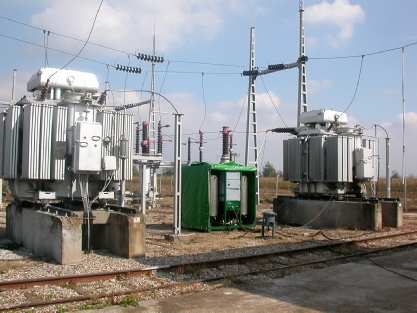
Dehydration of power transformers insulation
This is a process of oil-cellulose insulating system dehydration while the power
transformer is energized. It is performed on-site, on-line without transformer operation
interruption.
Process of drying includes the following:
» DEHYDRATION OF TRANSFORMER INSULATING OIL
Restoration of dielectric characteristics
» DEPTH DRYING OF CELLULOSE INSULATION
Guaranteed insulation characteristics after the treatment and within warranty period
of minimum twelve months
» Insulation resistance
» Water content in solid insulation
» Dielectric strength
» Water content in insulating oil
» Particles
Operation principle
Dehydration of power transformer insulation is based on adsorption of water as polar
compound from total insulation by creating continuous dynamic non-equilibrium (disbalance)
of its content between solid and liquid insulation.
Water constantly migrate (diffusion process) from paper to oil, where from it is
adsorbed by synthetic adsorbents, i.e. removed from insulation. This is achieved
by producing/creating continuous dynamic non-equilibrium.
Increased temperature stimulates diffusion process and therefore migration of of
water from paper to oil is more intense.
Long lasting insulating characteristics stability
Apart from above mentioned solid insulation characteristics (water content and insulation
resistance) proof of solid insulation depth drying are long lasting stability of
insulating oil characteristics.
Twelve months of transformer operation is generally long enough period for potentially
remained water in solid insulation to degrade characteristics of insulating oil.
As a proof of successfully implemented depth dehydration of solid insulation oil
characteristics within twelve month after treatment are usually guaranteed.
Transformer insulation dehydration significantly extends power transformer lifetime
and increases its operation reliability on the network.
In comparison with technologies available nowadays, oil-cellulose drying methods
using synthetic adsorbents have shown significantly better results, providing essential
changes in electro energetic equipment maintenance approach, primarily in maintenance
of oil-cellulose insulating systems in power transformers.
Goals and results of oil-cellulose insulating system drying
Goal of such treatment is to secure stabile characteristics of insulating system
for a long time in terms of water content, both in oil and cellulose.
By water removing as one of the main promoters of the oxidation process transformers
lifetime is significantly extended and their security on the network is increased.
Adsorbents for dehydration are absolutely neutral to all kinds of mineral oils and
can be reactivated virtually unlimited number of times. There is no inhibitor adsorption
or removal during oil dehydration.
Based on the fact that the amount of dissolved water in oil is small comparing to
amount in cellulose and that it is measured in ppm (mg/kg), it is concluded that
the classical methods of oil centrifuging, heating and vacuuming are limited to oil
dehydration only and often harmful. Increasing the temperature of the insulating
oil to above 60 °C and then drying it in the vacuum causes the loss of very important
natural inhibitors (light aromatics) which are necessary for good insulating quality
and oil lifetime. The efficiency of the process drops rapidly at lower temperatures
or in lower vacuum. Dehydration efficiency diagrams of temperature-vacuum correlation
are given by equipment manufacturers. Standard technologies require large and heavy
equipment that pollute environment and consume huge amounts of energy.
Transformer insulation dehydration main characteristics
» No oil heating
» No oil vacuuming
» No transformer vacuuming
» No natural inhibitor removal
» No fault gases removal
» Removal of water both from oil and cellulose in the same process
» New oil not required, thus saving resources
» Cost effective
» Ecology friendly (zero gas emission and no disposal of waste oil)
» Transformer washing not required
» No exposing of transformer core to atmosphere
» No loss of production (can be performed while transformer is energized)
» Reactivation of synthetic adsorbents for few hundred times
» Simple machinery construction
» Simple handling
» Easy installation
» Minimum supervision
» Field operation in all weather conditions
» Minimal power consumption (0.5-3 kW)
» Guaranteed results for long period of time